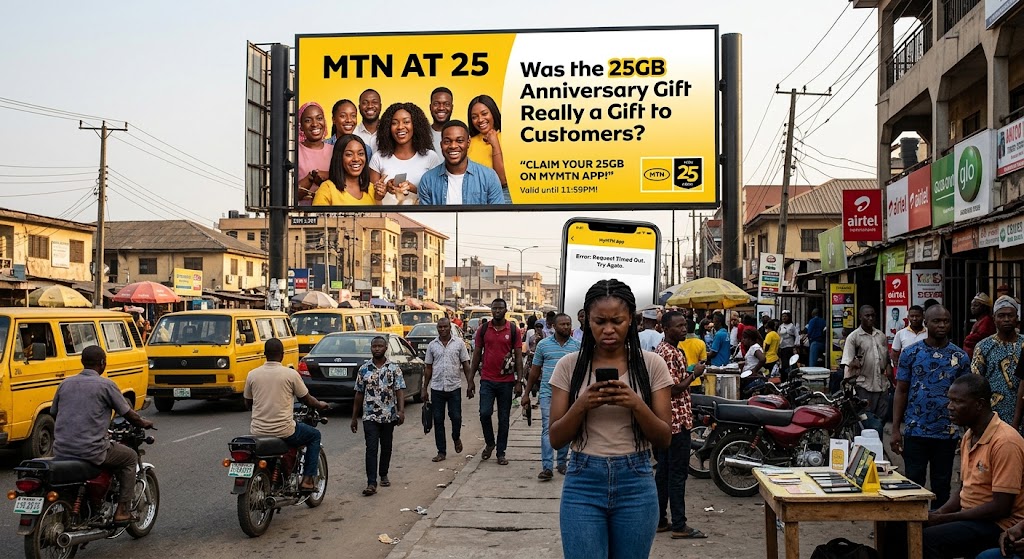
There was excitement when MTN Nigeria announced a 25GB data gift to mark its 25th anniversary in Nigeria.
For a country where mobile data has become almost as essential as electricity—and where consumers routinely complain about the rising cost of staying connected—25GB sounded like the kind of anniversary gesture customers would genuinely appreciate.
But for some subscribers, the excitement did not last long.
The problem was not necessarily the size of the data. It was the difficulty some customers encountered trying to claim and use it before the offer expired.
MTN had told customers about the anniversary bonus and directed them to its app to claim the 25GB. That immediately created a different experience from simply crediting the data to eligible customers’ lines.
For many subscribers, installing the app should have been a straightforward process.
It was not.

Some customers reportedly struggled to open the application, with network-related error messages appearing when they tried to access it.
And therein lies the irony.
MTN was celebrating 25 years in Nigeria by offering customers 25GB of data, yet some of those same customers could not reliably access the platform through which they were expected to claim the gift.
What should have been a celebration quickly became a race against time.
When free data becomes difficult to collect
Data is no longer a luxury for the average Nigerian.
Students need it for academic work. Business owners need it to communicate with customers. Workers depend on it for meetings and transactions. Families use it to stay connected. Content creators need it to produce and distribute their work.
And for many people, data is expensive.
That is why the announcement of 25GB naturally generated excitement.
But according to experiences shared by some customers, the difficulty started when they attempted to access the MTN app.
The anniversary gift came with a deadline: it was to expire at 11:59pm.
That meant every minute mattered.

Imagine receiving an offer of 25GB when data is expensive, only to spend a significant part of the day trying to open the application required to claim it.
For some subscribers, the frustration reportedly became worse as the day progressed.
Some were eventually able to access the app only a few hours before the deadline. Others struggled with slow browsing speeds, making it difficult to meaningfully use the data even after obtaining it.
At that point, the question was no longer whether customers had received 25GB.
The real question was: how many customers were actually able to enjoy it?
An anniversary gift should feel like a gift
There is nothing inherently wrong with asking customers to use an app to claim a promotional benefit.
Companies increasingly use their applications to manage customer rewards, promotions and loyalty programmes.
But when the benefit is tied to an extremely short validity period, the system delivering it has to work.
If customers must download an application, register or log in, navigate through the platform, claim the offer and then use the data—all within a few hours—the process needs to be seamless.
Otherwise, what was intended as a gift can begin to feel like a promotional exercise designed around conditions that customers must overcome.
This is particularly important when the company has already built a huge customer base over 25 years.
MTN did not become a major telecommunications company in Nigeria without Nigerians spending money on its services.
Customers have bought airtime.
They have purchased data.
They have subscribed to voice and internet packages.
Businesses have depended on the network.
Families have used it for years.
Students have relied on it.
Professionals have paid for it.
Some Nigerians have probably spent hundreds of thousands of naira on MTN services over the years. Some businesses and heavy users have spent considerably more.
So when the company celebrates 25 years, customers are entitled to expect a meaningful gesture.

Then came the network question
Perhaps the most frustrating part of the experience, based on what some customers reported, was the apparent contrast between the network experience during the day and shortly after midnight.
Subscribers attempting to claim or use the anniversary benefit complained about difficulties with the app and slow browsing.
Then, after midnight, when the 25GB offer was no longer useful to those whose access had been delayed, the network appeared to improve.
Some customers observed what looked like a brief network refresh around midnight, after which their connection became noticeably better.
That naturally raises questions.
Was there unusually heavy traffic because millions of customers were attempting to access the anniversary promotion at the same time?
Was the application infrastructure adequately prepared for the volume?
Was the network capacity sufficient for the expected demand?
Were customers warned that there could be congestion?
These are technical questions that MTN can answer far better than customers can.
And perhaps the company owes its subscribers an explanation.
Was 24 hours too short?
There is another issue that deserves attention: the decision to make the 25GB bonus expire within 24 hours.
Why?
If MTN wanted to celebrate 25 years with its customers, would extending the validity period to several days have significantly diminished the value of the gesture?
Would a week have been unreasonable?
Would a month have been too much?
Or, better still, why not simply give customers a meaningful amount of data without placing them under the pressure of a midnight deadline?
A 25GB bundle that expires in 24 hours may sound generous on paper.
But generosity is not measured only by the amount offered.
It is also measured by how accessible and usable the benefit is.
Giving someone a large meal and giving them five minutes to eat it are not necessarily the same as giving them a meal.

Customers deserve answers, not explanations after the fact
MTN has built one of Nigeria’s largest telecommunications businesses over the past quarter of a century.
With that position comes responsibility.
The company should therefore be able to explain what happened to customers who could not access the app, claim the bonus or meaningfully use the data because of network or application difficulties.
If millions of subscribers were trying to access the service simultaneously, was the company prepared for that demand?
If the app experienced problems, why was there no alternative way to claim the bonus?
And if customers could not use the 25GB because of circumstances beyond their control, what happens to them?
These are not unreasonable questions.
They are consumer questions.
A celebration customers should remember for the right reasons
There is also a reputational issue here.
A company celebrating 25 years wants customers to remember the anniversary.
But what exactly will some subscribers remember?
Will they remember receiving 25GB and enjoying a full day of free browsing?
Or will they remember spending hours trying to open an application, battling slow connectivity and watching the clock move towards 11:59pm?
Will they remember MTN’s anniversary with appreciation—or frustration?
That distinction matters.
A celebration is successful when the people being celebrated with actually feel celebrated.
MTN’s anniversary was an opportunity to turn millions of customers into willing storytellers: people who would tell friends, family and colleagues that the company had genuinely surprised them.
Instead, for some subscribers, the story became one of an attractive offer that was difficult to access and even more difficult to enjoy.

MTN still has an opportunity to get this right
It would be unfair to conclude that the anniversary offer was worthless simply because some customers encountered problems.
Nor should the experience of some subscribers be presented as the experience of every MTN customer.
But the complaints deserve to be heard.
If MTN sincerely intended the 25GB offer as a gift to its customers, it still has an opportunity to demonstrate that sincerity.
One possible solution would be to compensate eligible customers who were unable to claim or use the data because of documented technical difficulties.
Better still, MTN could extend the validity period or re-credit affected subscribers.
After 25 years in Nigeria, that would be a gesture worthy of the milestone.
The question is not whether MTN can afford another 25GB.
The question is whether the company understands what that 25GB represented to the Nigerian customer.
For some, it represented a day’s worth of connectivity without worrying about the next data purchase.
For others, it represented a rare opportunity to download, stream, communicate, work or study without watching their data balance disappear.
And for many, it was simply a thank-you from a company they had supported for years.
That thank-you should not become something customers have to struggle to receive.
MTN Nigeria has spent 25 years building its relationship with Nigerians.
It should ensure that its anniversary is remembered not for how quickly the 25GB expired, but for how generously and reliably it was delivered.
If technical problems prevented customers from enjoying a benefit that was promised to them, then perhaps the most appropriate anniversary gift now would be simple:
Give them the 25GB again—and this time, give them enough time and a reliable network to actually use it.
Submit a Press Release | Advertise With Fresh News | Contact Us