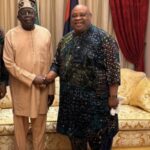
The decision to place former Humanitarian Affairs Minister Betta Edu in President Bola Tinubu’s 2027 campaign structure has reopened questions about the place of people facing corruption investigations in Nigerian politics.
Federal Capital Territory Minister Nyesom Wike has now weighed into the debate, arguing that being investigated by the Economic and Financial Crimes Commission does not, by itself, prevent a person from participating in political activities or campaigning for a candidate.
Wike spoke on Wednesday during a media parley in Port Harcourt, Rivers State, where he questioned the criticism surrounding the inclusion of a person under EFCC investigation in Tinubu’s campaign organisation.
“You (media) were asking the moral justification of putting someone who has an EFCC case to be in a campaign council. And I was just watching the lady. The lady doesn’t even know what to say,” Wike said.
He argued that political participation and criminal prosecution were separate issues, pointing to situations where people who had faced criminal allegations were still able to contest elections.

“Now, somebody cannot be in a campaign to canvass for votes for a particular person, but somebody who has an EFCC case can contest an election and win an election?”
Wike added that there had been cases involving politicians who were charged to court but later contested elections and emerged victorious.
“This person had an EFCC case in court, charged to court. He contested an election and became a Governor,” he said without identifying the individual.
The minister went further, using the example of a prisoner to illustrate his position that a person’s legal troubles do not necessarily remove their ability to express political support.
“Listen. Even a prisoner… maybe they have somebody in prison. I go and visit the person. The person can tell me, ‘My brother, I want you to support so-and-so candidate.’ A prisoner has canvassed for vote.”
Wike also referred to an unnamed person allegedly being sought over claims connected to a coup, arguing that political support had previously been sought or expressed by people facing serious allegations.
“I was watching, when Channels, when Sunrise, who came up to say, ‘Ah, how can somebody who’s being looked for as a coup plotter is now canvassing for votes for so-and-so government?’ Somebody EFCC is looking for is now canvassing for votes for so-and-so person.
“But… a party, or a candidate cannot, simply because EFCC is investigating the person, cannot be a member of the campaign council to campaign for votes.”
Why Betta Edu’s name is at the centre of the debate
The controversy is linked to events that began in January 2024, when Edu was removed from her position as Minister of Humanitarian Affairs and Poverty Alleviation.
At the time, President Tinubu suspended her from office and directed the EFCC to investigate financial transactions involving the ministry and agencies under it. The presidential directive said Edu was expected to cooperate with the investigation.
The decision followed controversy surrounding an approval involving about N585 million in ministry funds and a private account. Edu was subsequently questioned by the EFCC and released on bail while the investigation continued.
The investigation later expanded beyond the particular transaction involving Edu. The EFCC said its wider probe into the humanitarian affairs ministry uncovered alleged financial irregularities and reported recoveries running into billions of naira and millions of dollars. The investigation also examined issues involving COVID-19 relief funds, a World Bank loan and recovered assets.
Edu has not been publicly convicted of an offence arising from the investigation.
Her return to the political spotlight
The issue resurfaced in August 2026 after the All Progressives Congress unveiled its presidential campaign council for the 2027 election.
Edu was listed as Director of Women Mobilisation in the campaign council, placing her among the officials expected to contribute to the party’s mobilisation efforts for Tinubu’s re-election campaign.
Her appointment immediately attracted scrutiny because of the unresolved EFCC matter and the circumstances that led to her suspension from the Federal Executive Council.

The APC subsequently defended the decision.
Kemi Asekun-Shittu, a spokesperson for the campaign council, said Edu had not been found guilty and should not be prevented from participating in political life simply because an investigation remained pending.
“I’d like to say that for Betta Edu, for example, she has not been found guilty. And it will be unfair to ask that she leaves her life or refuses to live her life until the EFCC declares her. We believe that there is very likely the issue that she may not be found guilty.
“But besides that, we also know that with politics, every Nigerian is allowed to be a politician if they choose to. And we do not believe that we should then hold her life still or keep her stagnant until the case is decided. It’s been almost two years of that case.
“She does deserve an opportunity to present herself again for the party,” she said.
Asekun-Shittu further described the campaign council as an internal party arrangement and argued that the APC had the authority to determine who would serve on the team.
She also indicated that the list was not necessarily final and could still be reviewed if any of the appointments were found to conflict with applicable rules.
The larger question
The disagreement has brought attention to an important distinction in public accountability: an investigation is not the same as a conviction.
An investigation allows law enforcement authorities to establish whether an offence may have occurred and who may be responsible. A conviction, on the other hand, follows a judicial determination of guilt.
In Edu’s case, the EFCC investigation was ordered after her suspension from office, and she was questioned by the commission. However, there has been no publicly reported conviction against her arising from that investigation.

This distinction forms the basis of the argument advanced by Wike and the APC campaign spokesperson.
Critics of Edu’s inclusion, however, have focused on the political and ethical implications of giving a prominent campaign position to a former minister whose handling of public funds resulted in a presidential suspension and an anti-corruption investigation.
For the APC, the appointment reflects its assessment of Edu’s political usefulness and does not amount to a declaration that the investigation has been concluded in her favour.
For Wike, the issue is whether an unresolved investigation should automatically prevent an individual from campaigning.
As the 2027 election season gathers momentum, the debate over Edu’s role is likely to remain part of the wider discussion about accountability, political participation and the treatment of allegations before they are settled by the courts.
Submit a Press Release | Advertise With Fresh News | Contact Us