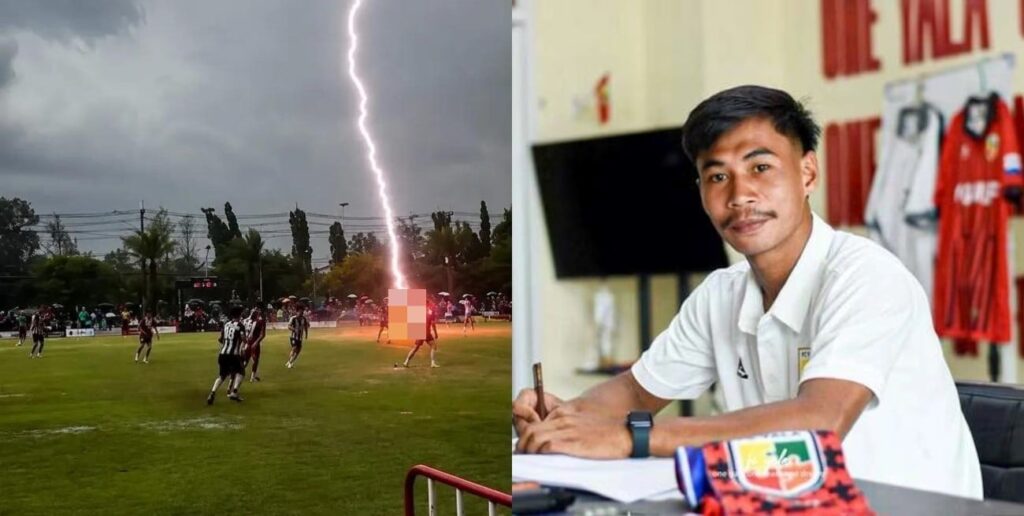
The death of a young footballer after a lightning strike during a match in southern Thailand has renewed concerns about player safety and the need for stricter weather protocols at football grounds, particularly in regions where thunderstorms are common.
The incident happened during a regional football tournament at Santiphap Stadium in Narathiwat province after heavy rain and a thunderstorm swept across the area. Players were still on the pitch when lightning struck, killing 24-year-old Safwan Awae and leaving 12 other people injured.
Emergency responders arrived shortly after the strike and treated those affected before transporting them to hospital. Authorities later confirmed that Awae died from the injuries he sustained despite efforts by medical personnel to save his life.

Police chief Thun Sirikhunt said, “Although the emergency medical team made every effort to save him, the victim succumbed to severe injuries sustained in the incident.”
Among those injured was 22-year-old Malaysian footballer Alif Ezzahan Zulkifli, who reportedly suffered burns during the same incident.
Football Matches and Lightning Risks
Although lightning-related deaths on football pitches are uncommon, experts have repeatedly warned that open fields become highly dangerous when thunderstorms develop. Metal goalposts, wet playing surfaces and the lack of nearby shelter can significantly increase the danger once lightning is detected.
Many football associations across the world now recommend suspending matches immediately after thunder is heard or lightning is seen nearby. Several competitions also follow the widely used “30-30 rule,” which advises stopping play when the time between seeing lightning and hearing thunder is 30 seconds or less, with activities resuming only after at least 30 minutes without another strike.
Sports safety organisations have continued to encourage clubs, schools and tournament organisers to monitor weather forecasts closely and avoid unnecessary risks during severe storms.
Similar Incidents in Football
The tragedy in Thailand is not the first time lightning has struck during a football event.
Over the years, several players, referees and spectators have either been killed or seriously injured after storms interrupted matches in different countries. In some cases, entire teams have escaped with injuries after lightning hit the playing surface, while other incidents have led football authorities to strengthen emergency weather guidelines.
Safety experts say such events highlight the importance of having evacuation plans and ensuring matches are halted before storms move directly over stadiums or open fields.

Club Pays Tribute
Awae had recently joined FC Yala, a club competing in Thailand’s third-tier Southern Region league.
Following the tragedy, the club paid tribute to the player in a message shared on Facebook.
The club wrote, “Indeed, we belong to Allah, and indeed, to Him we will return.”
It added, “Condolences to the family of Safwan Awae, the new player of FC Yala.”
Investigation Continues
Officials are expected to review the circumstances surrounding the incident as questions are raised over the safety measures that were in place when the storm intensified.
The tragedy has once again drawn attention to the importance of weather monitoring at sporting events, with safety advocates urging organisers to prioritise the protection of players, officials and spectators whenever severe weather threatens outdoor competitions.
Submit a Press Release | Advertise With Fresh News | Contact Us